I've sent another round of email invitations out, but I still don't think that is getting everyone on.
In the interim feel free to email your post to me and I'll make sure you get credit, and get it up here for
your classmates - jarrett.earnest@qc.cuny.edu
- Mr. Earnest
Tuesday, September 27, 2011

MIDTERM UPDATES
As we discussed, no class this week (Wednesday 28th)
The midterm will go on as scheduled on October 19th, that means when we return to class on October 5th we will discuss the study guide I will give you, and then go over any questions you have on October 12th.
Remember, for the slide ID portion, you need to know the 1) Artist's name, 2) the Title of the Work, 3) Date 4) an important fact about its significance to art history.
The midterm will go on as scheduled on October 19th, that means when we return to class on October 5th we will discuss the study guide I will give you, and then go over any questions you have on October 12th.
Remember, for the slide ID portion, you need to know the 1) Artist's name, 2) the Title of the Work, 3) Date 4) an important fact about its significance to art history.
Key Images - Week 4
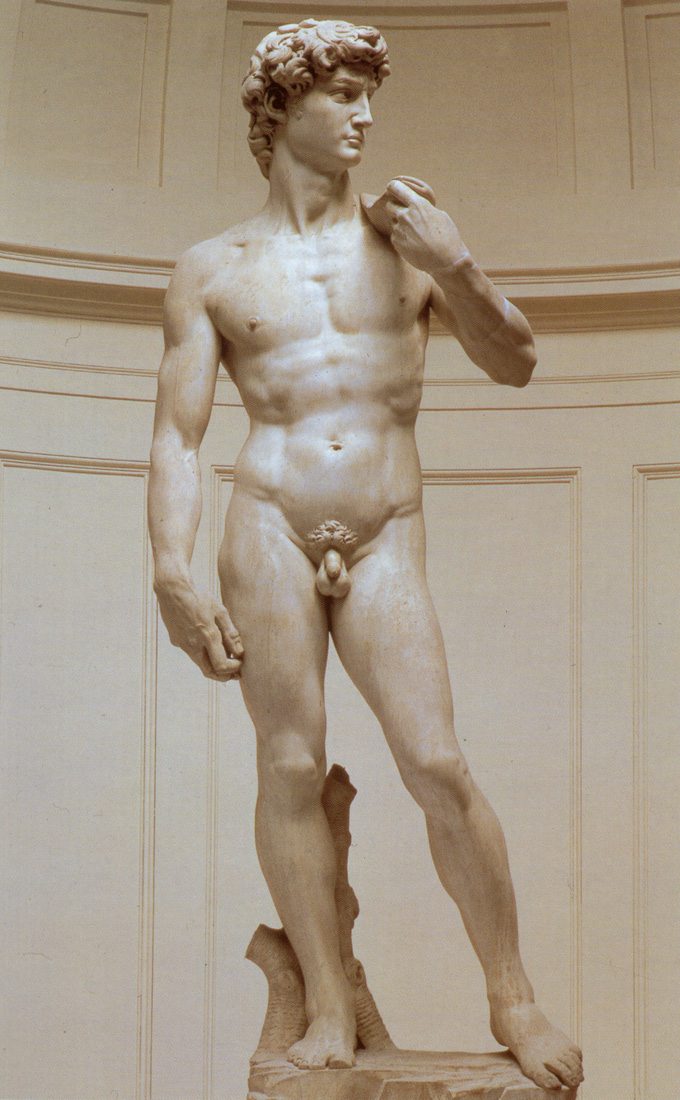
Michelangelo, David Location: , Date: 1501 -1504 Misc: marble Florence: Academy |
 |
Leonardo diVinci The Virgin of the Rocks . Location: LOUVRE,PARIS:, Date: 1483 -1486 |
 |
Leonardo diVinci Last Supper Location: S. MARIA DELLA GRAZIE,M, Date: 1495 -1497 |
 |
Raphael La Fornarina Location: Rome: Gall. Naz. d'Arte Antica, Date: circa 1520 |
 |
Michelangelo Sistine Chapel Creation of Adam Location: Vatican,Sistine Chapel, Date: 1511 -1512 |
 |
Raphael, School of Athens Location: Vatican:StanzaSegnatura, Date: 1510 -1511 |
 |
Raphael Madonna of the Meadows [Madonna del Belvedere] Location: Vienna:Kunsthist.Mus, Date: 1506 |
 |
Bronzino Allegory of Venus and Cupid Location: National Gallery, London, Date: - mid 1540s |
 |
Leonardo Madonna and Child with Saint Anne Location: Paris: Musee du Louvre, Date: circa 1507 |
 |
Pontormo Entombment/Deposition Location: Florence:Sta.Felicita, Date: 1525 -1526 Misc: oil on panel, 313x192cm, Capponi Chapel |
 |
Michelangelo Pieta Location: Rome:St.Peters Basilica, Date: 1498 -1499 |
 |
Leonardo diVinci Mona Lisa Location: Paris: Musee du Louvre, Date: circa 1503 |
 |
Parmigianino Madonna and Christ with Angels (Madonna of the Long Neck) Location: Florence: Uffizi, Date: before 1534 |
 |
Raphael Portrait of Baldassare Castiglione Location: Paris: Musee du Louvre, Date: 1514 -1515 |
 |
Rosso Fiorentino Descent from the Cross Location: Volterra:Pinacoteca, Date: 1521 |


Key Image - Week 3
 |
The Limbourg Brothers February, Life in the Coutry. Tres Riches Heures, 1411-1416 |
 |
Jean Fouquet Etienne Chevalier and St. Stephen, c.1452-1455 |
 |
Rogier van der Weyden Portrait of a Lady 1445 |
 |
Jan van Eyck The Betrothal of the Arnolfini 1434 |
 |
Hugo van der Goes Portinari Alterpiece (open) c. 1474 - 1476 |
 |
Hugo van der Goes The Death of the Virgin c.1480 |
 |
Hans Memling Virgin and Child of the Diptych of Maarten van Nieuwenhove c.1487 |
 |
Rogier van der Weden The Descent from the Cross c.1435 |
 |
| Jan Van Eyck Man, Portrait of Man in a Turban c. 1433 |
 |
Martin Schongauer Demons Tormenting St. Anthony 1480-1490 |
 |
Konrad Witz The Miraculous Draught of Fishes. 1444 |
 |
Claus Sluter The Prophets Daniel and Isaiah from the Moses Fountain, near Dijon c.1392-1402 |
 |
Stefan Lochner The Virgin in the rose-bower 1440 |
Monday, September 26, 2011
Architecture in Wall Paintings

Architectural design is often used in paintings to create an illusion of a three dimensional space. Most paintings are done on wood panel or canvas, both moveable materials, and therefore the space portrayed is limited to the framed scene. The placement of these works on a medium separate from the physical building, and thereby their framing, detaches it from the structure itself. Wall paintings, on the other hand, provide for an illusion of space beyond the physical walls of the architecture. They add depth to the rooms and almost extend the boundaries of the building by depicting scenes in architecturally structured areas.
Leonardo Da Vinci’s The Last Supper on the walls of the monastery of Santa Maria delle Grazie is an excellent example of this. The four pairs of tapestry on either side of the table extend the refectory into another room where the scene of the last supper would have mirrored that taking place in the actual room. Although very simple architecture is portrayed, the linear lines and the meeting of the ceiling with the three walls in the back, creates a very real illusion of added physical space.

http://www.metmuseum.org/toah/hd/leon/hd_leon.htm
Although Da Vinci uses a different method of wall painting, the concept has deep roots in Roman art. Four styles of wall painting evolve in the fresco method in the first century BCE. The effect of such designs was that of the illusion of the extension of physical boundaries through the paintings. The wall paintings at the Villa of P. Fannius Synistor at Boscoreale, near Pompeii, are clear predecessors of Da Vinci’s work. Although more elaborate in the depiction of architectural structures, the art opens the room to space outside the walls that stand there. The person standing in that room is exposed to city vistas and monuments placed in landscapes outside the boundaries of any four walls. These views are framed by architectural elements, such as columns, that could have been incorporated into the actual architecture of the room, providing for the illusion of a window. The clear depiction of architecture is what allows the resident or visitor of the villa to be exposed to a greater space than what the physical boundaries initially allow.

http://www.metmuseum.org/toah/works-of-art/03.14.13a-g
It is interesting to note, after I made the distinction between wall paintings and moveable ones, that this specific wall painting was actually partially moved to the Metropolitan Museum of Art, where its effect is not as strong as it is once again separated from the physical boundaries it seeks to extend.
Dalya Arussy
Friday, September 23, 2011
The History of Pigments
An interesting article on the history of pigments. It discusses the use of Lapis Lazuli during the Renaissance and the later discovery of Cobalt Blue in the 19th century.
another informative link about pigments:
-Carmen Cowick
Subscribe to:
Posts (Atom)